Selecting the right Forklift Solid Tires is not simply a matter of matching a tire diameter to a forklift. Tire construction, load requirements, tread design, working surfaces, operating temperatures, wheel configuration, and daily duty cycles all influence how a forklift performs. A well-matched solid tire can provide stable handling, reliable traction, resistance to punctures, and consistent support in demanding material-handling environments.
Select a section below to jump directly to the information you need.
- Why Does Tire Selection Matter So Much on a Forklift?
- What Should You Know About Tire Construction and Design?
- How Does the Operating Environment Affect Tire Selection?
- How Should Load Capacity and Operating Speed Be Evaluated?
- How Do Tread Patterns Influence Forklift Performance?
- How Do Solid and Pneumatic Forklift Tires Differ?
- What Should Be Checked Before Installation?
- How Can Operators Maintain Consistent Tire Performance?
- What Is a Practical Tire Selection Process?
- Frequently Asked Questions
Why Does Tire Selection Matter So Much on a Forklift?
A Forklift Solid Tires is part of the machine's working system rather than an isolated replacement component. The tires directly influence how the vehicle transfers its load to the floor, how smoothly it responds to steering input, and how effectively it maintains contact with the operating surface.
In a warehouse, a forklift may repeatedly accelerate, brake, turn tightly, reverse, and carry loads through narrow aisles. In an industrial yard, the same vehicle may encounter rougher surfaces, debris, moisture, temperature changes, and longer travel distances. These different conditions create different demands.
The purpose of selecting the correct tire is therefore to create a suitable balance between traction, stability, durability, ride characteristics, heat behavior, and load support. A tire that works well on a smooth indoor floor may not be the most appropriate solution for an outdoor yard with irregular surfaces.
Why Non-Pneumatic Construction Can Be Important
Solid construction removes the need to maintain internal air pressure. This can be particularly useful in environments where sharp debris or constant contact with hard surfaces creates a higher risk of pneumatic tire damage.
The absence of an air chamber also changes how the tire reacts under load. Instead of relying on internal air pressure for support, the rubber structure and its internal construction carry the working forces. This makes compound selection and construction quality particularly important.
Why Operator Comfort Still Matters
Solid does not have to mean excessively harsh. Modern designs can incorporate resilient compounds and cushioning structures that absorb part of the vibration transmitted from the floor to the forklift. This becomes relevant when operators spend many hours driving over concrete, expansion joints, warehouse thresholds, or imperfect industrial surfaces.
What Should You Know About Tire Construction and Design?
Different solid tire designs are developed around different performance priorities. Resilient constructions generally focus on shock absorption and ride characteristics, while press-on designs are tightly fitted to a specified wheel assembly. Clip-on or easy-fit solutions are designed around installation convenience and particular wheel configurations.
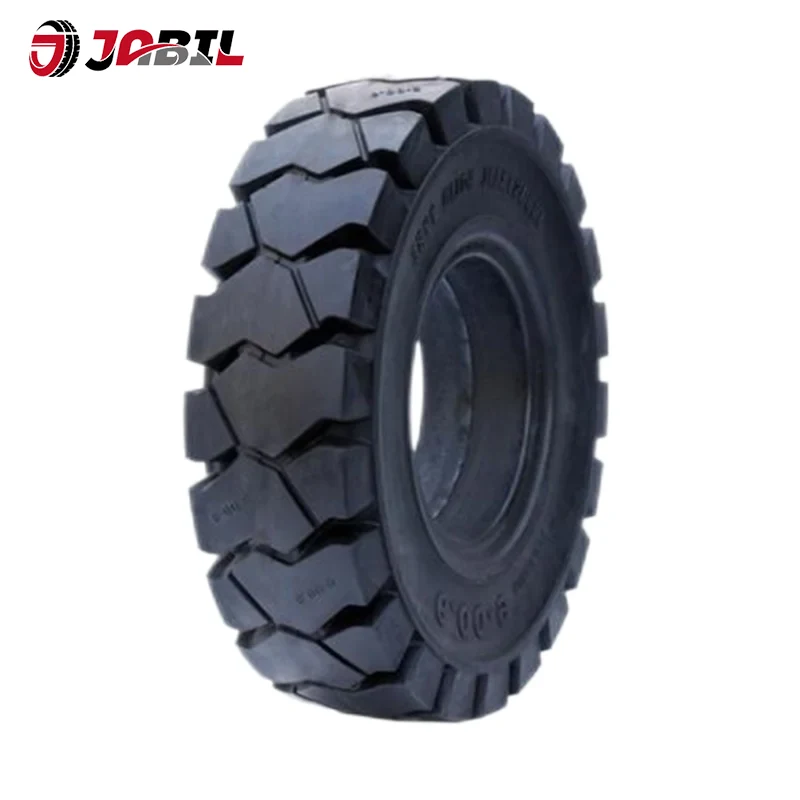
One useful way to understand solid tire construction is to consider the tire as a system of functional zones. The outer tread interacts with the floor. The intermediate section manages a combination of cushioning and force transfer. The base section interfaces with the wheel assembly and contributes to overall structural stability.
Typical Construction Considerations
- Tread compound: Influences wear resistance, traction, floor interaction, and resistance to cuts or abrasion.
- Cushioning or buffer area: Helps manage vibration and impact while the forklift travels across uneven surfaces.
- Base construction: Provides structural support and ensures compatibility with the wheel or rim assembly.
- Heat management: Becomes increasingly important during long periods of continuous movement.
- Tread geometry: Determines how the tire interacts with dry, wet, smooth, or irregular surfaces.
Some products use multi-stage rubber formulations to achieve different characteristics across the tire. A harder outer area may be designed for wear resistance, while a softer internal area can help improve cushioning. The exact formulation should be matched to the intended operating environment rather than judged by softness alone.
Resilient, Press-On, and Clip-On Configurations
| Configuration | Typical Construction | Main Characteristic | Important Fit Consideration |
|---|---|---|---|
| Resilient | Rubber-based solid construction | Cushioning and balanced ride characteristics | Wheel and mounting dimensions |
| Press-On | Solid tire fitted onto a compatible wheel assembly | Stable fit for suitable industrial applications | Press-on band and wheel specifications |
| Clip-On | Solid tire designed around a clip or locking mechanism | Convenient replacement and installation | Correct clip-on wheel configuration |
The mounting system is not interchangeable simply because two tires appear similar in size. Wheel width, rim diameter, construction, and mounting method must all be verified before ordering or installation.
How Does the Operating Environment Affect Tire Selection?
The same forklift model can require different tire characteristics depending on where it works. A tire operating inside a clean warehouse faces different conditions from one used at a port, recycling facility, manufacturing plant, construction yard, or cold-storage site.
Indoor Warehouses
Smooth concrete and epoxy floors usually place greater emphasis on predictable steering, controlled traction, low vibration, and reduced floor marking. Non-marking formulations can be appropriate where black tire marks are undesirable, such as clean production areas, food-related facilities, hospitals, or finished-floor environments.
Outdoor Industrial Areas
Outdoor operations can expose tires to dust, gravel, moisture, rough surfaces, and debris. In these conditions, tread depth, sidewall strength, compound durability, and resistance to cuts or impacts become more significant.
Cold or Temperature-Sensitive Environments
Temperature can influence rubber behavior. Extremely cold conditions may change the flexibility of some compounds, while prolonged high-temperature operation can increase heat accumulation within a tire. A compound designed for the intended temperature range helps maintain more consistent behavior.
Specialized Workspaces
Some facilities require tires with particular properties such as low marking, anti-static behavior, or flame-related performance characteristics. These applications should be evaluated as specialized engineering requirements rather than treated as standard tire replacement.
- Clean-floor application: Consider non-marking compounds and suitable traction characteristics.
- Rough industrial surface: Prioritize cut resistance, structural durability, and appropriate tread geometry.
- Continuous-duty operation: Pay close attention to heat generation and compound behavior.
- Wet surface: Review drainage-related tread features and traction performance.
- Special environment: Confirm whether anti-static, low-marking, or other application-specific requirements apply.
How Should Load Capacity and Operating Speed Be Evaluated?
Load capacity is one of the most important technical factors when selecting a forklift tire. The tire must be capable of supporting the loads imposed by the forklift, the carried material, and the dynamic forces generated during movement.
It is not enough to look only at the maximum rated capacity of the forklift. The axle load distribution, whether the tire is fitted to the drive or steer position, operating speed, and working conditions can all affect the actual requirement.
Drive and Steer Positions Can Have Different Requirements
Drive tires transmit acceleration and braking forces to the floor, so traction and durability are especially important. Steer tires experience repeated lateral forces during turning and maneuvering. The same dimensions do not automatically mean identical operating demands.
Speed Changes the Working Load
Operating speed affects dynamic forces, heat generation, and handling response. A tire suitable for slow warehouse movement may not be appropriate for a machine that regularly travels at a higher operating speed over longer distances.
| Evaluation Factor | Why It Matters | Information to Confirm |
|---|---|---|
| Forklift Rated Capacity | Defines the general load-handling requirement of the machine | Forklift identification plate and manufacturer data |
| Actual Working Load | Reflects the real loads encountered during operation | Typical and maximum handled loads |
| Drive or Steer Position | Different tire positions experience different forces | Wheel position and axle arrangement |
| Operating Speed | Influences dynamic loading and heat behavior | Normal travel speed and duty cycle |
| Surface Condition | Changes traction, impact, and wear requirements | Concrete, epoxy, asphalt, gravel, ramps, thresholds, and debris |
Always use the manufacturer's rated load information for the selected tire. A general assumption based on forklift tonnage alone is not a substitute for the specific tire load specification.
How Do Tread Patterns Influence Forklift Performance?
Tread design determines how the tire engages with the working surface. A tread pattern must provide sufficient contact and traction without creating unnecessary vibration or excessive material wear.
Deep Grooves
Grooves can help channel water away from the primary contact area and support traction on damp surfaces. However, tread depth should be considered together with the actual operating environment. A pattern designed for wet outdoor use may not provide the same comfort or floor interaction as a pattern developed for smooth indoor concrete.
Block and Rib Patterns
Different arrangements influence directional stability, steering response, and contact behavior. Block-oriented patterns can provide strong multidirectional engagement, while rib-like designs may deliver more predictable rolling behavior on smooth floors.
Heat and Tread Geometry
During continuous operation, tread deformation generates heat. Tire construction, rubber formulation, tread pattern, vehicle speed, load, and floor conditions all influence thermal behavior. The goal is not simply to choose the most aggressive pattern but to choose one that matches the duty cycle.
For indoor warehouses, a balanced pattern with predictable steering and controlled vibration may be preferable. For rougher surfaces, stronger resistance to cuts, impacts, and irregular contact may become more important.
How Do Solid and Pneumatic Forklift Tires Differ?
Solid and pneumatic tires serve different operating priorities. Pneumatic tires use compressed air to provide cushioning and support. Solid tires use their material structure to carry the load and maintain shape.
In environments where punctures, sharp debris, or frequent tire damage are major concerns, solid construction can offer a practical advantage because there is no air chamber that can suddenly lose pressure after a puncture.
Pneumatic tires can provide a softer ride in certain outdoor applications because compressed air naturally contributes to cushioning. Solid tires, in contrast, are often selected where stability, puncture resistance, and predictable support are more important.
| Characteristic | Solid Construction | Pneumatic Construction |
|---|---|---|
| Puncture Risk | No air chamber to puncture | Can be affected by punctures and air loss |
| Pressure Maintenance | No inflation pressure adjustment | Requires correct air pressure |
| Ride Behavior | Depends strongly on compound and construction | Air pressure contributes significantly to cushioning |
| Warehouse Use | Well suited to many smooth indoor applications | Can be used where permitted by surface and machine requirements |
| Rough-Surface Use | Suitable when the selected design is rated for the environment | Can provide useful cushioning, but puncture exposure must be considered |
The correct choice depends on the forklift, surface, operating conditions, and safety requirements. Neither construction should be selected solely because it is commonly used in a particular industry.
What Should Be Checked Before Installation?
Correct fit is just as important as tire performance. A tire that has the correct nominal diameter but does not match the wheel configuration can create installation and operating problems.
- Confirm the tire size. Record the complete size marking, including width, diameter, and any special designation shown on the existing tire.
- Verify the wheel or rim. Check rim width, diameter, mounting design, and the required installation method.
- Confirm the forklift position. Determine whether the tire is for a drive, steer, or another specified wheel location.
- Check the load requirement. Match the tire load rating to the actual operating conditions and manufacturer specifications.
- Review the application environment. Consider indoor or outdoor use, floor type, moisture, debris, temperature, and duty cycle.
For non-standard requirements, accurate technical information becomes even more important. Rim width and diameter can help identify the correct custom configuration, but additional dimensions and operating data may also be needed.
Why Incorrect Fit Can Affect Performance
An incorrectly fitted tire can influence steering response, wheel alignment, load transfer, and wear patterns. It can also create installation difficulties or reduce the intended contact between the tire and wheel assembly.
Professional installation should follow the applicable equipment and tire procedures. Mechanical force should be applied only with suitable equipment and trained personnel.
How Can Operators Maintain Consistent Tire Performance?
Solid tires do not require inflation pressure checks, but they still require inspection. Regular visual and operational checks can identify developing problems before they become more serious.
- Inspect tread wear: Look for uneven wear, unusual pattern changes, or areas that appear to be wearing faster than expected.
- Check the sidewall: Examine for significant cuts, cracks, separation, impact damage, or deformation.
- Inspect the mounting area: Look for movement, damage, or abnormal conditions around the wheel interface.
- Observe steering behavior: Pulling, vibration, unusual noise, or changes in maneuverability can indicate a problem.
- Monitor operating conditions: Repeated overheating, aggressive turning, excessive loads, or unsuitable surfaces can accelerate wear.
Uneven Wear Is Useful Information
Uneven wear can indicate alignment issues, incorrect loading, repeated sharp turns, unsuitable operating surfaces, or differences between operating positions. The wear pattern should therefore be investigated rather than treated as a normal consequence of use.
Cleaning and Workplace Conditions
Keeping the operating area reasonably clear can also protect tire performance. Metal fragments, broken pallets, sharp debris, and other foreign objects can create excessive stress even when the tire itself is puncture-resistant.
Maintenance records can be useful for fleet operators because recurring wear patterns may reveal that the operating condition, tire selection, or forklift setup needs further technical review.
What Is a Practical Tire Selection Process?
A structured selection process helps reduce uncertainty and ensures that technical requirements are considered before purchasing or installing replacement tires.
A Technical Checklist for Procurement Teams
- Forklift information: Model, capacity, axle arrangement, and operating position.
- Tire dimensions: Complete size marking and wheel compatibility.
- Load data: Typical operating load and required safety margin according to applicable specifications.
- Speed: Normal working speed and continuous operating period.
- Surface: Concrete, epoxy, asphalt, gravel, ramps, thresholds, or mixed surfaces.
- Environment: Temperature, moisture, debris, chemical exposure, clean-room requirements, or special safety requirements.
- Performance priority: Traction, wear resistance, floor protection, cushioning, heat behavior, or installation convenience.
For organizations operating multiple forklift models, it is useful to keep a tire specification record for each machine. This avoids relying on visual similarity when ordering replacements and makes it easier to identify the correct tire configuration.
Forklift Solid Tires should ultimately be selected by matching the complete technical profile of the forklift with its working environment. Dimension, load, tread, compound, construction, wheel configuration, and operating conditions work together to determine practical performance.
What Technical Information Helps a Supplier Recommend a Suitable Tire?
Clear technical information can make the selection process more accurate. The most useful details normally include the existing tire marking, wheel or rim dimensions, forklift model, operating environment, load requirements, and the expected duty cycle.
Photographs of the existing tire sidewall and wheel assembly can also help identify markings and mounting characteristics, but measurements and manufacturer data should remain the primary technical references.
Frequently Asked Questions
Are solid tires suitable for indoor forklifts?
Yes. Solid tires are widely used on forklifts operating in warehouses and industrial facilities. The appropriate design depends on floor type, required traction, load, speed, turning pattern, and whether floor marking must be minimized.
Do solid forklift tires need air pressure checks?
No. Solid construction does not rely on compressed air, so routine inflation-pressure maintenance is not required. Visual inspection and monitoring of tread, sidewalls, wheel fit, and operating behavior are still important.
What is the difference between resilient and press-on construction?
Resilient designs typically use an all-rubber solid construction with an emphasis on cushioning and balanced performance. Press-on designs are fitted onto a compatible wheel assembly and have specific mounting requirements. The correct option depends on the forklift and wheel configuration.
Can solid tires be used on wet floors?
They can be used in suitable wet-floor applications when the selected tread and compound provide appropriate traction. Surface condition, drainage, operating speed, and braking behavior should all be considered before selecting a tire.
Are non-marking options available for clean floors?
Yes. Non-marking solid tire compounds are designed for environments where black marks or residue on the floor are undesirable. They are commonly considered for facilities with polished, coated, or otherwise sensitive flooring.
How do I know whether a tire can support my forklift load?
Use the tire manufacturer's specified load rating and compare it with the forklift's actual operating conditions. The correct assessment should consider tire position, speed, axle loading, and the working load rather than relying only on the forklift's nominal capacity.
Can solid tires be produced for non-standard requirements?
Custom configurations may be possible when sufficient technical information is available. Rim width, rim diameter, tire dimensions, operating load, speed, surface, and application conditions can help determine whether a customized design is technically suitable.
How frequently should solid tires be inspected?
Inspection frequency should reflect the intensity of use and workplace conditions. High-duty fleets benefit from regular visual checks and prompt inspection whenever operators notice unusual vibration, steering behavior, noise, tread wear, or damage.
Need help reviewing tire dimensions, wheel compatibility, load requirements, or application conditions?
Contact us for technical guidance on the right forklift tire configuration.For manufacturer background and production information, visit JABIL.