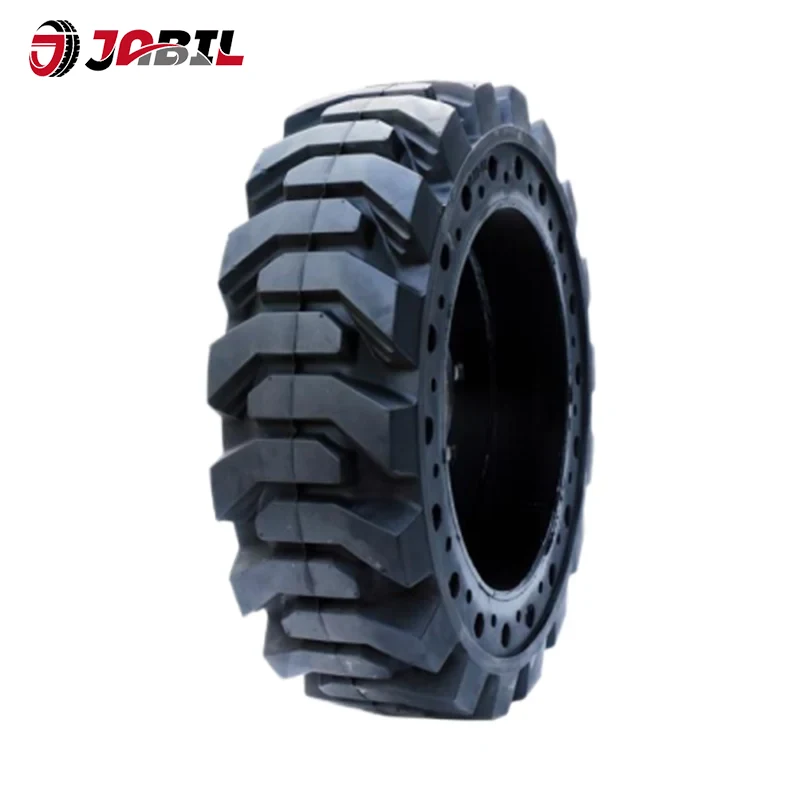
Web Pattern Skid Steer Tires
Web Pattern Skid Steer Tires represent a specialized category of solid tires engineered for skid steer loaders operating in demanding environments where traction, durability, and puncture resistance are paramount. The web-type design integrates foreign advanced technology—a hybrid construction that combines the quick-installation convenience of traditional pneumatic rim-type solid tires with the structural integrity of steel rim press-fit solid tires. This technological combination delivers the lightweight, shock-absorbing characteristics of a pneumatic-style tire with the maintenance-free reliability of a solid tire. The result is a tire that offers excellent shock absorption, faster heat dissipation, and strong traction on complex surfaces—making it ideal for skid steer loaders operating in construction, landscaping, demolition, and recycling applications.
Product Positioning & Application Scope
Web Pattern Skid Steer Tires are specifically designed for skid steer loaders—one of the most versatile vehicle classes in the compact equipment segment. These machines operate across a wide spectrum of environments, from construction sites and demolition yards to landscaping projects and recycling facilities. The web pattern tread design is optimized for applications where traction on complex surfaces is essential.
Key application areas include:
• Construction & Demolition: Rough terrain, debris-strewn worksites, and scrap handling where puncture resistance is critical.
• Landscaping & Agriculture: Diverse ground conditions requiring reliable traction without excessive ground damage.
• Recycling & Waste Management: Harsh environments with sharp debris where pneumatic tires would fail within hours.
• General Industrial: Paved surfaces and heavy-duty service requiring both traction and durability.
The web pattern design is particularly suited for applications requiring a balance of traction, ride comfort, and durability—making it a versatile choice for fleet operators managing diverse job site requirements.
Technical Specifications & Load Ratings
The following table provides complete specifications for the Web Pattern Skid Steer Tires product line. Load ratings are provided for both 10km/h and 26km/h operating speeds, with separate ratings for drive and steer axle positions.
|
Tire Size
|
Rim
|
Pattern
|
Diameter mm
|
Section Width mm
|
Drive Width mm
|
Load Capacity (kg)
|
|
10km/h
|
26km/h
|
|
Drive
|
Steer
|
Drive
|
Steer
|
10-16.5
(31×6×10)
|
10-16.5
|
YY-105
|
756
|
255
|
239
|
4230
|
3080
|
3630
|
2680
|
12-16.5
(33×6×11)
|
12-16.5
|
YY-105
|
820
|
273
|
264
|
4575
|
3875
|
3815
|
3400
|
20.5/70-16
(36×7×11)
|
FB
|
YY-105
|
895
|
284
|
277
|
6450
|
5350
|
5870
|
4550
|
Specification Notes:
• The 20.5/70-16 (36×7×11) size delivers the highest load capacity in this product line, rated at 6,450 kg for drive axle applications at 10km/h.
• YY-105 is the designated web pattern design, featuring the world-popular engineering classic tread pattern.
• Load capacity decreases as speed increases—note the reduction from 10km/h to 26km/h ratings across all sizes.
Core Features & Design Advantages
The Web Pattern Skid Steer Tire incorporates several design features that distinguish it from conventional solid and pneumatic alternatives:
Quick & Easy Installation:
The web-type design enables rapid installation without requiring specialized equipment. Unlike traditional press-fit solid tires that demand hydraulic presses, the web-type construction mounts similarly to pneumatic tires while delivering the durability of solid rubber. This reduces installation time and eliminates the need for specialized mounting equipment.
Lightweight Construction:
The web pattern design reduces tire weight compared to conventional solid tires. Lower unsprung weight translates to reduced impact on vehicle load, improved machine responsiveness, and potentially lower fuel consumption. While solid tires are naturally heavier than pneumatics, the web-type design minimizes this weight penalty.
Superior Shock Absorption:
The web-type construction provides excellent shock absorption characteristics. This is particularly important for skid steer operators working extended shifts in rough terrain, as improved ride comfort reduces operator fatigue. The design bridges the comfort gap between traditional solid tires (known for firmer rides) and pneumatic tires.
Faster Heat Dissipation:
The web pattern structure promotes faster heat dissipation during operation. Heat buildup is a primary factor limiting solid tire service life—excessive heat can cause compound degradation and premature failure. The web design's improved thermal management extends tire service life.
World-Popular Tread Pattern:
The YY-105 tread pattern is engineered for strong traction on complex surfaces. The web pattern design provides the traction characteristics demanded by skid steer operators working in diverse conditions, from loose gravel to paved surfaces.
Application Performance Characteristics
The web pattern tread design delivers specific performance advantages across different operating environments:
Complex Surface Traction:
Skid steer loaders frequently operate on surfaces that change rapidly—from concrete to gravel to mud to debris. The web pattern's tread design provides consistent traction across these transitions, reducing wheel spin and improving machine control.
Reduced Impact on Vehicle Load:
The lightweight construction and shock-absorbing characteristics of web pattern tires reduce the impact forces transmitted to the vehicle. This can extend the service life of suspension components, bearings, and other drivetrain elements.
Improved Operating Speed:
The combination of reduced weight and efficient tread design enables improved operating speeds. For fleet operators, this translates to increased productivity and faster cycle times.
Puncture-Proof Reliability:
As solid tires, web pattern skid steer tires eliminate downtime from punctures and flats. In demolition, scrap handling, and concrete recycling environments, solid tires remain operational where pneumatic tires would fail within hours. Solid tire construction ensures high robustness and reliable protection against cuts and other damage when operating in rough terrain.
Competitive Benchmark — Web Pattern Skid Steer Tires Compared
The following comparison evaluates Web Pattern Skid Steer Tires against three common alternatives in the skid steer tire market:
|
Parameter
|
Web Pattern Solid Tire
|
Conventional Solid Tire
|
Pneumatic Skid Steer Tire
|
Foam-Filled Pneumatic
|
|
Installation Method
|
Quick & easy—no press required
|
Press-fit—requires hydraulic press
|
Standard mounting—requires inflation
|
Standard mounting—requires filling
|
|
Tire Weight
|
Lightweight—reduces vehicle load impact
|
Heavier—adds unsprung weight
|
Lightweight
|
Heavy—filled with foam
|
|
Shock Absorption
|
Excellent—web design cushions ride
|
Firm—minimal cushioning
|
Excellent—air provides cushioning
|
Firm—minimal cushioning
|
|
Heat Dissipation
|
Fast—web structure promotes cooling
|
Moderate—solid construction retains heat
|
Good—air circulation aids cooling
|
Poor—foam retains heat
|
|
Puncture Resistance
|
Excellent—solid construction
|
Excellent—solid construction
|
Poor—vulnerable to punctures
|
Good—foam resists punctures
|
|
Operator Comfort
|
Good—balanced between solid and pneumatic
|
Firm—higher vibration transmission
|
Excellent—cushioned ride
|
Firm—minimal cushioning
|
|
Service Life (harsh conditions)
|
3–5× longer than pneumatic
|
3–5× longer than pneumatic
|
Baseline—shortest service life
|
1.5–2× longer than pneumatic
|
|
Total Cost of Ownership
|
Lowest—long life + quick installation
|
Low—long life, higher installation cost
|
Highest—frequent replacements
|
Medium—moderate life, higher initial cost
|
Key Differentiators:
• Installation Efficiency: Web pattern tires can be installed quickly without specialized equipment, reducing downtime and eliminating the need for hydraulic presses.
• Weight & Load Impact: The lightweight web design reduces impact on vehicle load, improving machine responsiveness and efficiency.
• Thermal Management: Faster heat dissipation extends service life and maintains performance consistency during extended operation.
• Ride Quality: Excellent shock absorption bridges the comfort gap between traditional solid tires and pneumatics.
Frequently Asked Questions
Q1: What is a "web type" solid tire, and how is it different from a conventional solid tire?
The Web Type solid tire is a technological combination of the traditional pneumatic tire rim-type solid tire and the steel rim press-fit solid tire. This hybrid design enables quick and easy installation similar to pneumatic tires, while delivering the puncture-proof durability of conventional solid tires. The web structure also provides better shock absorption and faster heat dissipation than conventional solid designs.
Q2: What does the YY-105 tread pattern designation mean?
YY-105 is the designated pattern for the web-type skid steer tire. It features the world-popular engineering classic tread pattern characterized by strong traction suitable for complex surface roads. The pattern design provides reliable grip across diverse operating conditions while maintaining self-cleaning capabilities.
Q3: How does the service life of web pattern solid tires compare to pneumatic tires?
Solid tires, including web pattern designs, typically last at least three times longer than pneumatic tires in comparable applications. Under harsh conditions, the lifespan can be three to five times longer. Solid tires also eliminate downtime from punctures and flats.
Q4: Are web pattern skid steer tires suitable for paved surface operation?
Yes. The web pattern design provides traction suitable for paved surfaces and heavy-duty service. The YY-105 tread pattern offers consistent performance across varied surfaces—from concrete to gravel to debris.